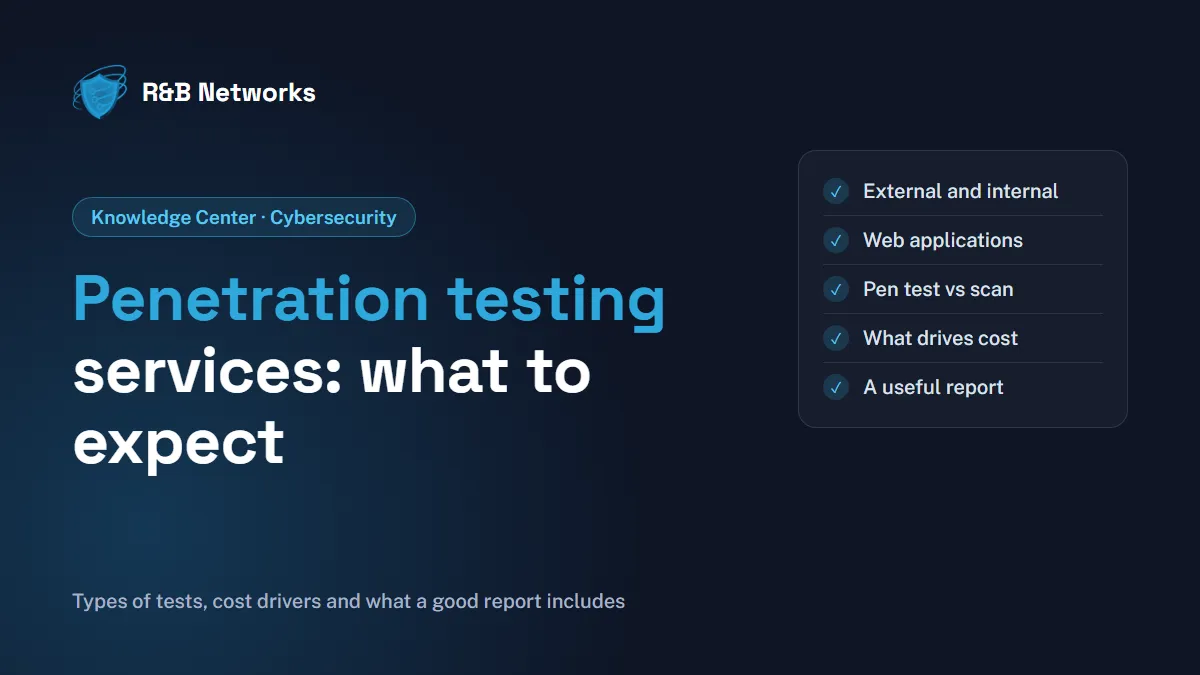
Sooner or later, someone asks for a penetration test. It might be a cyber insurance application, a large customer’s security questionnaire, a PCI DSS requirement, or simply a leadership team that wants to know whether its defenses would hold up against a real attacker.
Quotes for penetration testing services can vary widely, and it is not always obvious why. This guide explains the main types of tests, what drives the cost, what a good report should contain, and how a pen test differs from a vulnerability scan, so your Orange County business can compare proposals with confidence.
What is penetration testing?
A penetration test (pen test) is an authorized, simulated attack on your systems. Skilled testers use the same techniques real attackers use to find weaknesses, then try to exploit them in a controlled way to show what an attacker could actually reach: email accounts, file servers, customer data or administrator access.
The goal is not just a list of problems. It is evidence of which weaknesses matter most, how they could be chained together, and what to fix first.
Is penetration testing illegal? Not when it is authorized. A legitimate test always starts with written permission from someone who has the authority to grant it, plus agreed rules of engagement: what is in scope, what is off limits, testing dates and times, and who to call if something unexpected happens. Testing systems without that permission is illegal, which is one reason to work only with providers who insist on a signed scope before they begin.
Types of penetration tests
Most businesses need one or more of these:
- External network testing: looks at everything reachable from the internet, such as firewalls, VPNs, remote access portals, email and public servers. This is where most attacks begin.
- Internal network testing: assumes an attacker is already inside, for example through a phished employee or an infected laptop, and tests how far they could move: other computers, servers, backups and administrator accounts.
- Web application testing: examines websites, customer portals and online applications for flaws such as weak logins, broken access controls and injection vulnerabilities. Testers typically follow a recognized methodology such as the OWASP Web Security Testing Guide.
- Cloud and Microsoft 365 testing: reviews how cloud services are configured, including identity, sharing and administrator settings.
- Wireless testing: checks whether office Wi-Fi can be accessed or abused, and whether guest and corporate networks are properly separated.
- Social engineering and phishing: tests whether staff can be tricked into clicking, sharing credentials or approving requests. See our guide to phishing, smishing and vishing.
Penetration test vs vulnerability scan
These are often confused, and they are not interchangeable.
| Vulnerability scan | Penetration test | |
|---|---|---|
| How it works | Automated tool checks for known weaknesses | Skilled testers attempt real attacks |
| Frequency | Continuous, weekly or monthly | Typically annually and after major changes |
| Output | List of potential issues, with false positives | Verified findings, proof of impact, attack paths |
| Best for | Ongoing hygiene and patch tracking | Validating defenses and meeting requirements |
The two work together. Regular scanning catches new issues between tests, and a pen test shows whether the issues that remain could actually be exploited. Our article on regular vulnerability management scans explains the scanning side.
What drives the cost of a penetration test?
Rather than a single price, a penetration test is quoted on scope and effort. The main cost drivers are:
- Number of targets: external IP addresses, internal devices and network segments, office locations.
- Number and size of applications: a simple website takes far less time than a customer portal with multiple user roles.
- Type of test: “black box” testing (testers start with no information) usually takes longer than “gray box” testing (testers receive some access or documentation), though gray box often finds more in the same time.
- Depth and methodology: a quick automated assessment labeled as a pen test costs less, but delivers much less. Ask how much of the work is manual.
- Compliance requirements: frameworks such as PCI DSS require penetration testing at least annually and after significant changes, with specific scope rules for systems that handle card data.
- Retesting: confirming that fixes worked is sometimes included and sometimes billed separately.
- Timing: testing outside business hours to avoid disruption can affect the schedule and cost.
When comparing quotes, make sure each one covers the same scope. A much lower price often means fewer targets, less manual testing or no retest.
What a good penetration test report includes
The report is what you are really paying for. A useful one contains:
- An executive summary in plain English for leadership: overall risk, the most important findings and what to do next.
- The scope and methodology: what was tested, when, how, and against which standard (for example NIST SP 800-115 or the OWASP testing guide).
- Detailed findings, each with a severity rating, evidence such as screenshots, the business impact and clear steps to fix it.
- Attack narratives showing how individual weaknesses could be combined, for example from a phished password to administrator access.
- Prioritized recommendations, separating quick wins from longer projects.
- A retest summary confirming which issues have been resolved.
If a sample report is mostly raw scanner output, keep looking.
How to prepare for a penetration test
- Define your goals: compliance, insurance, a customer requirement or a genuine security check.
- Agree the scope in writing, including any systems that must not be touched.
- Tell the right people, such as your IT team, managed service provider and hosting providers, so a simulated attack is not mistaken for a real one.
- Back up critical systems before testing begins.
- Plan time to fix findings. Many of the same issues show up on insurance applications, so the work often pays off twice. See the security controls insurers now expect.
How R&B Networks can help
R&B Networks is based in Fountain Valley and serves small and mid-size businesses across Orange County and Southern California. Our managed cybersecurity services include penetration testing and vulnerability assessments, along with vulnerability management, 24/7 managed detection and response from a security operations center with human analysts, and help fixing what a test finds. Our engineering team includes professionals holding active ISC2 CISSP, Microsoft Azure Solutions Architect, Cisco CCIE and VMware credentials.
The bottom line
Penetration testing services are priced on scope: how many systems and applications are tested, how deep the testing goes and whether retesting is included. A good test is authorized in writing, largely manual, and ends with a report that explains real business risk and what to fix first. Pair it with regular vulnerability scanning to stay protected between tests.
Have questions about penetration testing services? Get a free assessment or call us at 949-323-8837.